
Italy’s multiplicity principle: moving away from model-centric AI Governance
Edition #160 interweave talks to AGID's director Mario Nobile about Italy's new AI Governance model, and how it can form the future direction in Europe...


Most global conversations around AI governance are currently focused on the model layer: which systems are high-risk, which should be audited, and which should be restricted.
So too in Europe, where much of the public debate around the European Union’s AI Act has centered on these foundational model risks and capabilities. Italy is beginning to move in a different direction.
Italy’s Agency for Digital Italy (AGID) is advancing a broader, full-stack approach to AI governance, one that looks beyond models to the infrastructure and systems that support them.
Its framework spans three complementary documents covering the adoption, development, and procurement of AI systems in public administration, with the development and procurement guidelines having closed public consultation in April 2026.
To better understand these guidelines, interweave’s team spoke with Mario Nobile, Director General of AGID, earlier this spring.
A full-stack approach to AI Governance
AGID’s framework argues that governments should govern every layer of the AI stack: energy, chips, infrastructure, models, and applications.
Rather than evaluating AI systems solely on model performance or risk classification, the framework encourages assessment across broader socio-economic and operational dimensions, including energy use, infrastructure resilience, interoperability, scalability, and long-term institutional capability.
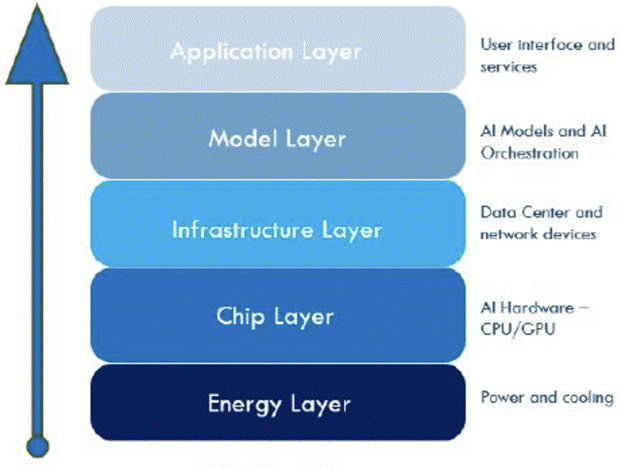
AGID’s approach to governance looks across the AI stack, not just at model safety. Source
This stack-wide view extends to how AI systems behave once deployed.
The framework introduces an autonomy classification ranging from L0 to L5, modeled loosely on self-driving car taxonomies, where agentic systems follow an observe-decide-act loop and higher autonomy levels trigger stronger governance and traceability requirements.
Italy places most current deployments between L2 and L3, with L5 reserved for research; a way of tying the abstract question of “is there a person behind this?” to concrete oversight obligations.
As a result, this integrated approach to AI means asking governance questions that are often overlooked in mainstream AI debates:
What happens if preferred compute infrastructure becomes unavailable?
Can systems operate in lower-capacity environments as fallback options?
Can governments migrate systems without excessive technical or financial costs?
These are not simply technical procurement questions. They are questions of resilience, state capacity, and technological sovereignty.
As Nobile explains, the goal is to avoid lock-in “not only from the point of view of the model, but the entire system.”
This approach also reshapes procurement.
By emphasizing portability, reversibility, interoperability, and lifecycle sustainability, the framework seeks to ensure that public administrations retain meaningful operational flexibility even after adoption. In practice, this reframes AI governance as a question of institutional agency and strategic autonomy, not merely model safety.
Multiplicity over monopoly
At the center of the framework is what could be described as a “multiplicity principle”: governments should preserve the ability to operate across multiple AI architectures, providers, infrastructures, and deployment environments simultaneously.
Rather than treating open-source and proprietary AI systems as opposing ideological camps, the guidelines assume governments will work across multiple architectures at once: proprietary, open-weight, cloud-based, on-premise, and hybrid systems.
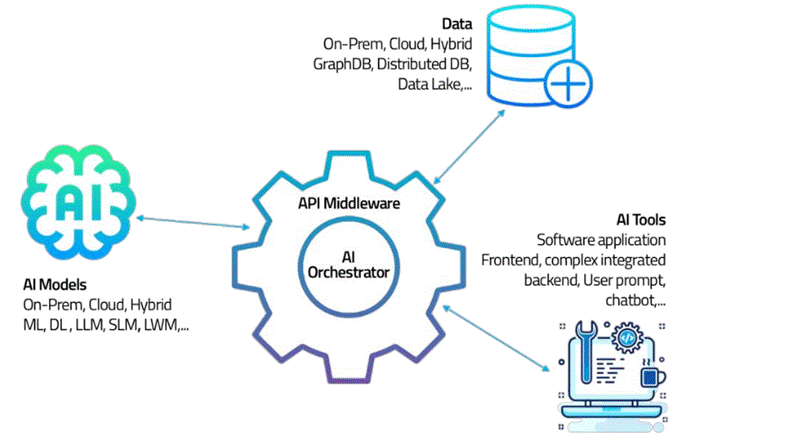
Italy’s AI-orchestrating infrastructure aims to support model multiplicity. Source.
“The future will be multiplicity,” Nobile tells interweave.
This is a subtle but important shift. Much of today’s AI governance debate implicitly assumes convergence around a small number of dominant providers or architectures. AGID’s framework instead treats dependency itself as a governance risk.
Under this approach, models are evaluated less on ideological preference and more on functional criteria such as governability, explainability, portability, and long-term operational performance. Italy may be among the first governments attempting to operationalize AI pluralism as state policy.
The framework also introduces the idea of a “Levelized Cost of AI” (LCOAI): evaluating AI systems not only by upfront performance, but by their full operational lifecycle, including infrastructure spending, retraining, governance overhead, migration expenses, cloud consumption, and transition costs.
In procurement terms, this shifts attention away from short-term capability gains toward long-term dependency risk and institutional flexibility.
Governance, trust, and institutional capability
At a broader level, Italy’s framework also attempts to reduce public anxiety around AI adoption by strengthening institutional capability rather than slowing deployment altogether.
“I want everyone to feel better, with confidence that no one is replacing them,” Nobile says.
The guidelines explicitly frame AI systems as tools intended to support workers rather than replace them. They aim to build institutional awareness around how AI may affect workflows while ensuring that human oversight and administrative understanding remain central.
At a time when much of the AI governance debate remains focused on model risks alone, AGID’s framework offers a different vision, one centered on institutional agency, operational flexibility, and technological sovereignty.
Moving away from asking governments to simply trust the systems they adopt, this Italian framework emphasizes their ability to continue understanding, governing, and adapting those systems over time.
Building institutional capacity to classify operator roles, calculate lifecycle costs, and enforce portability clauses requires skills and bandwidth that most public administrations are still developing. Italy’s guidelines acknowledge this but the value of a serious framework is in what it makes possible to ask for, to measure, and to expect over time.
That, quietly, is what changing the terms of the conversation looks like.
 | A guest post by
|
 | A guest post by
|